Introduction
The global demand for coconut coir substrates is at an all-time high, driven by the expansion of hydroponic greenhouses and professional nurseries worldwide. Because India (particularly Tamil Nadu) is a primary manufacturing hub, bulk buying involves importing ocean containers of compressed coir blocks.
For B2B buyers, distributors, and commercial growers, purchasing coir is not just about price. Unprocessed or poorly prepared coir can contain toxic sodium levels, crop pathogens, or fail to expand. Knowing the key quality metrics to verify is essential to securing a reliable growing medium.
Why Quality Matters in Coir Exports
Unlike manufactured synthetic substrates, coconut coir is an organic material harvested from natural fields. Raw coconut husks contain high levels of sodium, potassium, and chloride ions because coconut palms thrive near coastal soils. If these salts are not chemically replaced and washed out, they will compete with plants for water, causing stunted growth or root death.
Quality control at the factory level ensures raw husks undergo thorough processing cycles—including aging, washing with clean fresh water, buffering, and drying—to meet international agronomic standards.
Moisture Level
Moisture content in exported coir is a critical logistical and structural parameter. The standard export specification allows a maximum moisture content of 15% (ideally between 10% and 12%).
There are two reasons why moisture levels are strictly monitored:
- Transit Safety: High-moisture blocks shipped inside dark, humid ocean containers for weeks are susceptible to mold growth and bacterial decomposition.
- Shipping Weight: Ocean freight cost is dependent on weight. Excess moisture means the buyer is paying to ship water rather than dry coir material, reducing container load efficiency.
EC (Electrical Conductivity) Level
Electrical Conductivity (EC) measures the concentration of soluble salts in the substrate. This is the single most important agronomic metric for buyers:
- Low EC (Washed Coir): Has an EC level below 0.5 mS/cm (using 1:1.5 dilution). This coir has been thoroughly washed with fresh water. It is safe for immediate planting.
- Buffered Coir: Extends washing by using calcium and magnesium nitrate solutions to displace potassium and sodium bound to the coir particle complex. Essential for salt-sensitive crops like strawberries.
- High EC (Unwashed Coir): Has an EC level above 1.5 mS/cm. It is unwashed, rich in salts, and cannot be used directly for crops. It is suited for soil erosion mats or industrial landscaping.
Compression & Expansion Quality
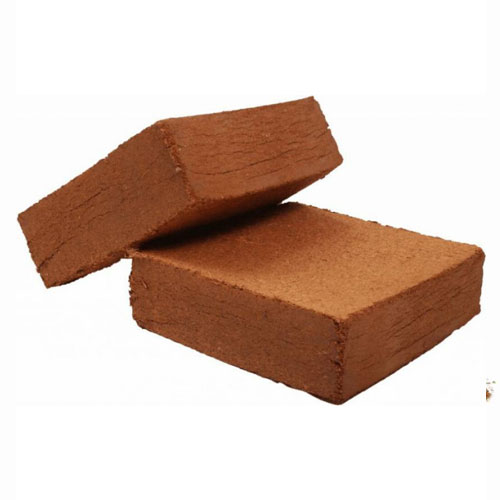
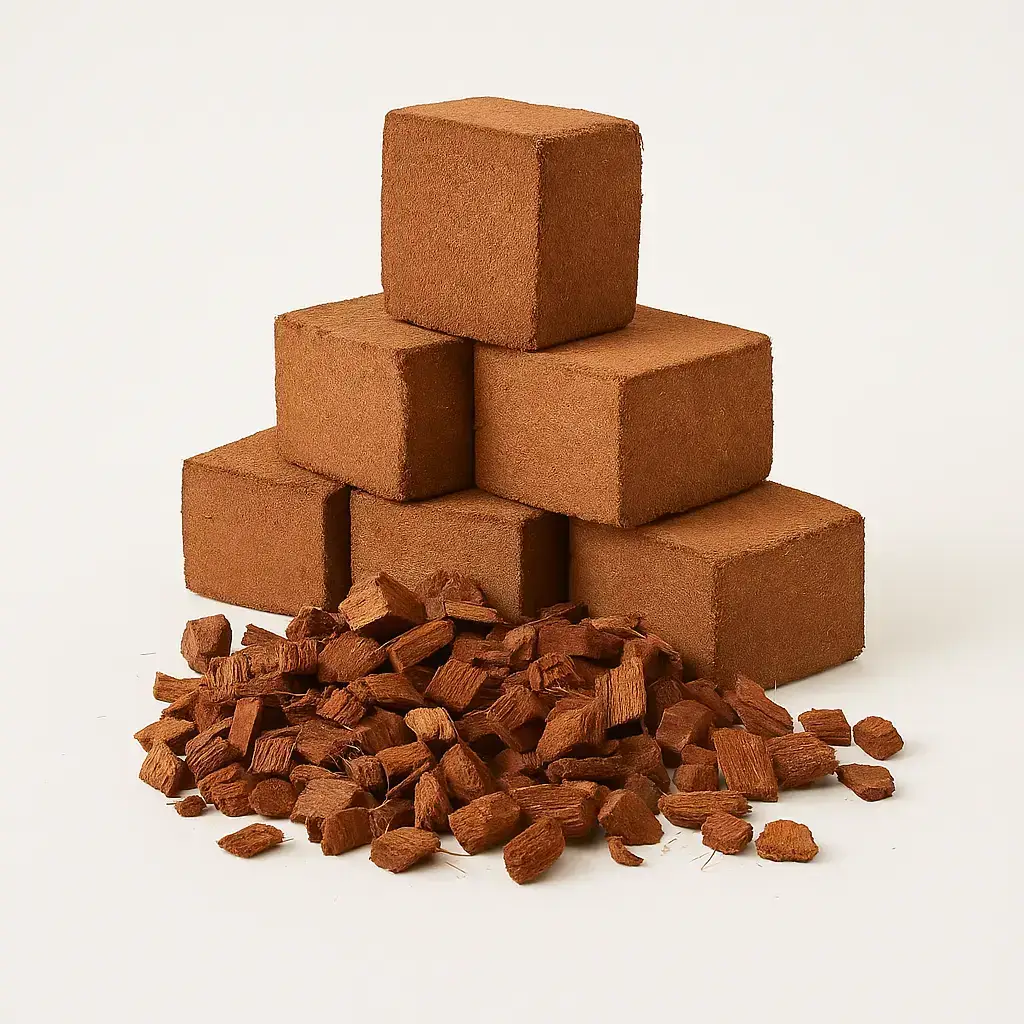
Standard export coco peat is compressed at a 5:1 ratio. A standard 5kg block measures approximately 30 x 30 x 10 cm, making it dense and highly stackable.
During quality inspection, buyers should verify the Expansion (Breakout) Volume. A high-quality 5kg block should expand to approximately 75 to 80 liters of loose coir when hydrated. If the block contains excess fine dust (pith) or was compressed under damp conditions, the particles stick together and fail to rehydrate fully, yielding lower volumes.
Packaging & Palletization Quality
During ocean transit, blocks are subject to heavy movement and humidity. Buyers should request specifications on packing options:
Palletized Packing: Blocks are stacked on wooden pallets, secured with corner protectors, and stretch-wrapped. A standard 40' High Cube container fits 20 pallets, carrying about 22 to 24 metric tons (approx. 4,400 blocks). This is ideal for automated warehouses where forklifts unload the container.
Bundle Packing: Blocks are strapped together in plastic-wrapped bundles of 3 to 5 blocks and hand-loaded. This maximizes container space, carrying up to 26 metric tons (approx. 5,200 blocks), but requires manual labor for container devanning.
Product Consistency & Sieving
Lastly, ensure the coir has been properly sieved. Standard sizes include 1/4 inch (6mm) or 1/2 inch (12mm) screens. Sieve screening removes large husk shards and separates fine dust. Too much dust causes water-logging; too many large shards cause rapid drying. Verification of the particle size distribution ensures the physical characteristics remain consistent from block to block.
Buyer Technical Checklist
Keep this technical snapshot handy when negotiating B2B contracts with manufacturers:
| Parameter | Export Specification Standard | How to Test |
|---|---|---|
| EC (Washed) | < 0.5 mS/cm (1:1.5 dilution method) | EC Meter testing in aqueous filtrate |
| pH Level | 5.8 – 6.8 | pH electrode meter |
| Moisture Content | 10% – 15% maximum | Halogen moisture analyzer / oven dry |
| Expansion Volume | 15 Litres per 1kg of dry coir substrate | Hydrate sample block in calibrated tank |
| Sieve Grading | Under 10% dust (particles < 1mm) | Sieve shaker analysis |